Divorce is an important life step that can be emotionally draining for many couples in Canada. Things can become even more complicated if you don’t know the appropriate divorce process steps.
Understanding how to file for divorce in Ontario can help you initiate your divorce smoothly. Fortunately, you don’t have to look any further to learn more about legally divorcing your spouse. Here is a step-by-step guide to help you initiate and finalize your divorce in Canada.
What Is Divorce In Canada?
Divorce is the legal termination of a marriage in Canada under the federal Divorce Act. The general rules that apply to the divorce process in the country include:
- You and your spouse are married under Canadian laws or under another country’s laws, but the marriage is recognized in Canada
- Your marriage has broken down
- You or your spouse has lived in the Canadian province where you filed for divorce for a complete year before applying for divorce
The federal Divorce Act only grants a divorce to Canadian residents, making it essential for one of the spouses to live in the country. However, an exception may apply to accommodate non-residents in certain circumstances.
What Are The General Rules Of Divorce For Non-Residents In Canada?
If neither you nor your spouse lives in Canada, you may be able to end your marriage in the country under the Civil Marriage Act upon meeting two conditions. This is called dissolution of marriage for non-resident spouses. The conditions include:
- You got married in Canada
- You cannot legally end your marriage in your current country of residence because it does not recognize the Canadian marriage
You can apply to the Ontario Superior Court of Justice under the Civil Marriage Act. Note that this law only ends marriages and does not resolve key issues between spouses, such as spousal support.
For matters such as child support and spousal support, laws in your country of residence will apply, and you’ll have to resolve these issues there. Consulting a family lawyer may be advisable to understand what you need to do to get a divorce as a non-resident.
What Are The Grounds For Divorce In Canada?
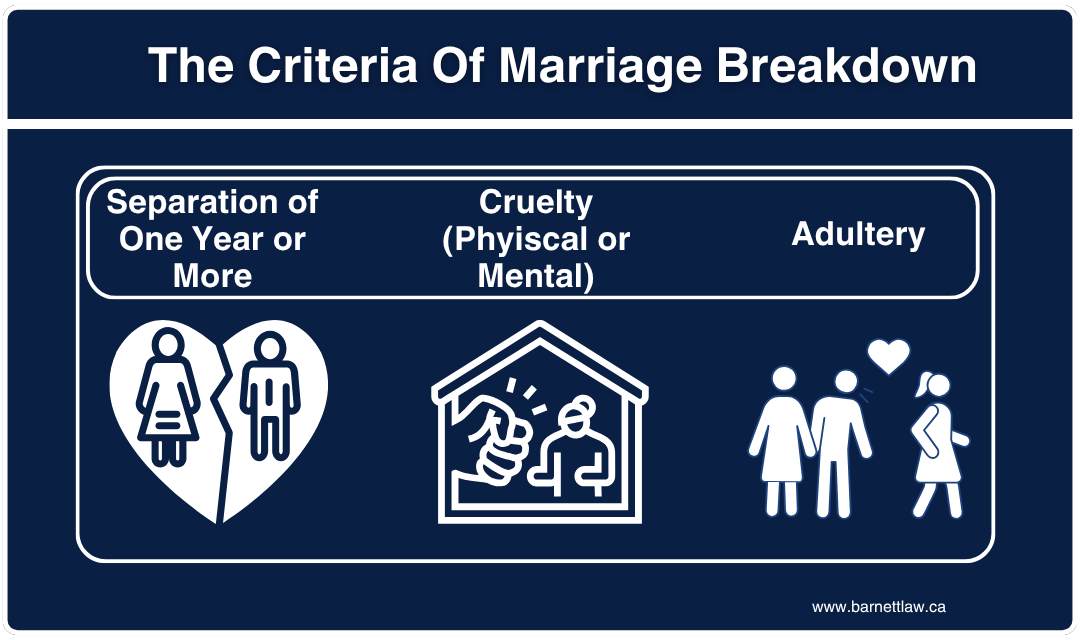
Canada has a no-fault divorce system, which means there is only one ground for divorce: marriage breakdown. You can show your marriage has broken down by applying one of the following criteria:
- You and your spouse have been living apart for one year or more
- Your spouse has been cruel to you (physically or mentally)
- Your spouse committed adultery
Couples who apply for divorce using the criterion of living apart can live together for up to 90 days before or after filing the application to reconcile. This period of reconciliation doesn’t reset the one-year limit of separation. If things don’t work out, you can continue with the divorce process as if the reconciliation period didn’t happen.
Some couples also separate but live in the same house. In such circumstances, they live in different portions of the same house with separate finances, food, accommodation, and social lives. A family lawyer may help you understand better what factors to consider when separating but living in the same house.
How To File For Divorce In Ontario: Step-By-Step Divorce Process
Starting the divorce process in Ontario requires you to fill out the appropriate forms for your province or territory. A divorce lawyer may do this work for you to help you adhere to Canadian laws. Let’s look at the complete steps of the Canadian divorce process:
Ensure Eligibility Through The Grounds For Divorce
Ensuring eligibility is always the first step of all divorce processes in Canada. Since the country has a no-fault-based divorce system, you must ensure one of the earlier-mentioned three criteria applies to your case.
You and your spouse must also have lived in the province of divorce filing for at least one year. This is a general rule that applies to all divorce cases under the federal Divorce Act.
If you and your spouse are non-residents, you will be ineligible for divorce under the Divorce Act. Instead, you will have to apply for dissolution of marriage under the Civil Marriage Act.
Determine The Type Of Divorce To File For In Ontario
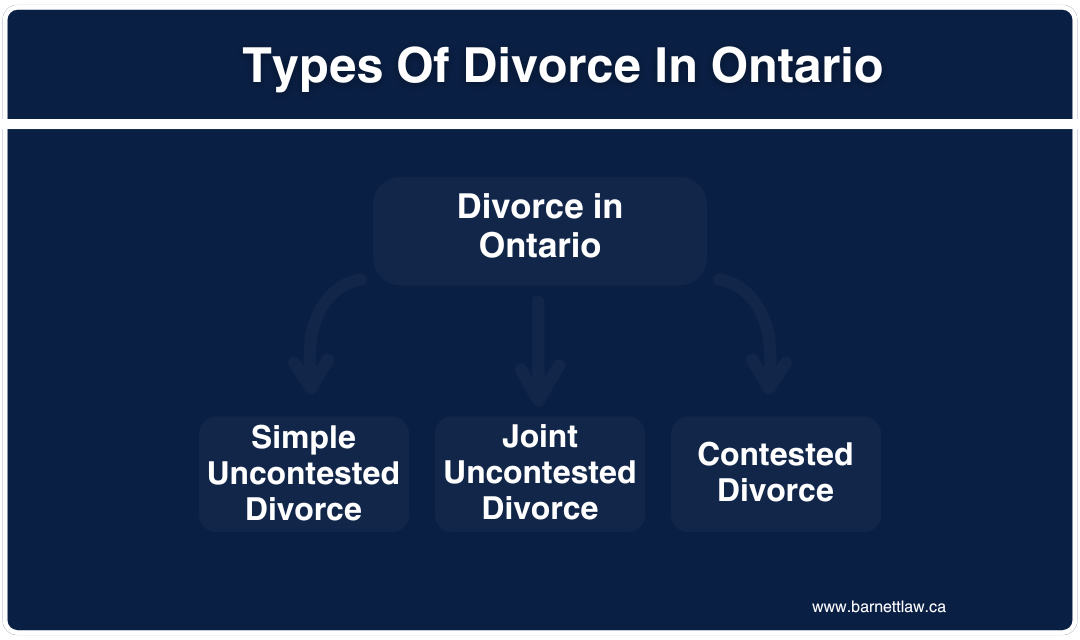
A divorce can be of three types: joint uncontested divorce, simple uncontested divorce, or contested divorce. Uncontested divorces are those in which the couple agrees on all key issues related to the process, such as property division, child support, matrimonial home division, and spousal support.
Meanwhile, a contested divorce is the process where one or both spouses don’t agree on one or more key issues related to the divorce. Contested divorces are usually lengthier than uncontested ones due to extensive involvement of the court system.
A divorce in Ontario may also be simple or joint. A simple divorce is one in which one of the spouses has filed a divorce application and must serve a notice of divorce to the other spouse. On the other hand, a joint divorce is a process in which both spouses mutually file the application, so there is no need to send a notice to your spouse.
Fill Out The Appropriate Forms
The Canadian divorce process may involve provincial and territorial courts under federal law. This is why you must gather the appropriate forms according to the province or territory in which you’re filing for divorce. For example, Ontario residents must use the following forms:
- Form 8 for contested divorce or divorce with additional relief
- Form 8A for uncontested divorces
Every province has their own forms for a smooth divorce process in Canada. Consulting a professional divorce lawyer may help you understand and gather the correct forms for ending your marriage.
File The Divorce Application With The Right Court
Most couples face significant difficulties when determining the right court for filing for divorce. It is essential to file the application in the municipality where your spouse or children live. For example, if you and your spouse live in Scarborough, Toronto, you must file the divorce application with the Ontario Superior Court of Justice in the Greater Toronto Area.
Similarly, if your spouse lives in another area, such as the region of Peel, you must file a divorce application with the Ontario Superior Court of Justice in Brampton. The Ontario government also has an online portal that allows you to file for a simple or joint divorce.
Serve Divorce Notice To Your Spouse
If you filed for a simple divorce in Ontario, you must serve a divorce notice to your spouse that includes a copy of the divorce application. The step is mandatory so that your partner can know about the proceedings and take any necessary steps. You can serve the notice to your spouse using the following methods:
- Serve the notice in person
- Send the notice through email
- Use a process server to serve the notice on your behalf
Upon serving the notice, you’ll have to wait 30 days for your spouse to respond if they’re in Canada or 60 days if they’re outside the country. Note that the step is only mandatory for simple divorces in Ontario. Joint divorces don’t require this step because your spouse would already know about the proceedings.
Prepare For A Potential Meeting With A Judge (Contested Divorce Only)
A potential meeting may be scheduled with a judge if your spouse challenges the divorce notice or if you filed for a contested divorce. The meeting’s purpose is to discuss the disputes of divorce and is called a case conference. If there’s no consensus during the meeting, a settlement conference may be scheduled to help you and your spouse negotiate an agreement.
If no consensus can be reached after the settlement conference, a trial conference will take place, after which a court trial will proceed. Having a skilled divorce lawyer by your side is essential during the meetings to present your demands and make informed decisions.
Present A Motion And Undergo Trial (Contested Divorce Only)
Contested divorces can become complex easily, necessitating a trial to resolve the issues. In such a situation, you will have to work with a professional divorce lawyer to build a strong case. Each party will get a chance to present its demands with appropriate reasoning.
The court will consider all the arguments presented during the trial to issue a fair verdict. You and your spouse will have to uphold the decision, but you may be able to appeal the decision in some cases.
Receive Your Divorce Order
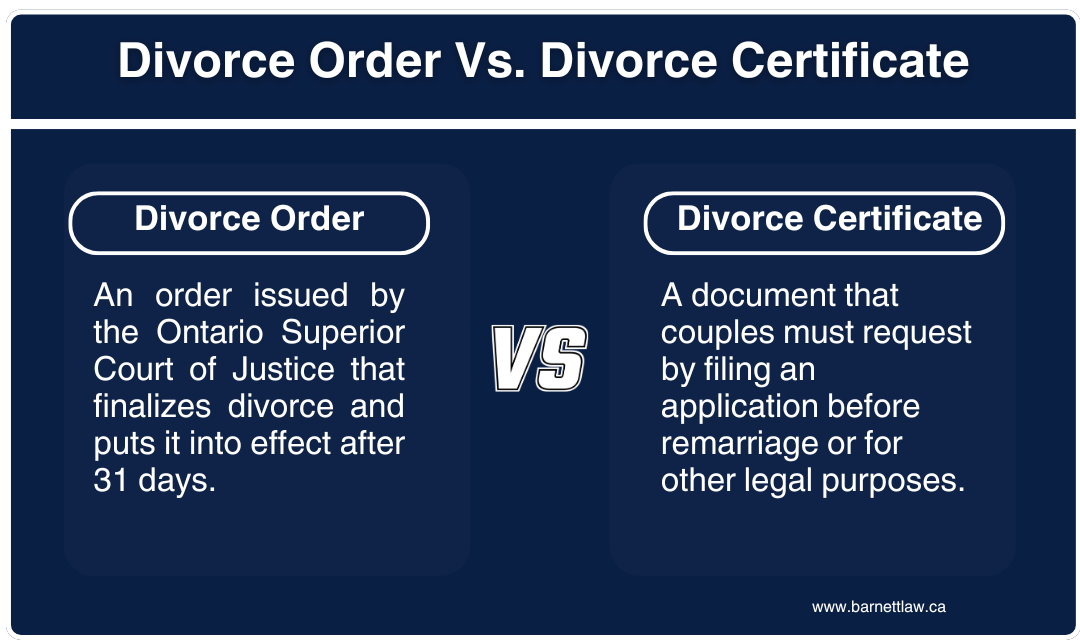
A judge will grant the divorce if the application is complete and complies with the federal Divorce Act. Once the divorce is granted, you will receive a divorce order. A divorce order finalizes the divorce process and states that the divorce will be effective 31 days after the order was made.
However, you and your spouse can waive the 31-day effective period by agreeing and signing an undertaking that states both of you will not appeal the judgment. You must also demonstrate special circumstances, such as legal reasons or immediate remarriage. A judge will review the request and determine whether or not to waive the waiting period.
In some provinces, you may have to obtain a divorce certificate after finalization. The certificate states the exact date of divorce and is required before you can remarry in some Canadian provinces. This document of divorce application also serves as legal evidence in other circumstances.
How Long Does A Divorce Take In Ontario?
The type of divorce and the complexity of your case determine how long the divorce process will take. For instance, a simple or joint divorce in Ontario takes four to six months. Compared to other options, this uncontested divorce is simpler and less expensive.
However, it may take longer than a year if you are going through a contentious divorce and need to resolve issues like custody, support, assets, etc. It is better to discuss this with an experienced divorce lawyer, who will assess the complexity of your divorce and estimate its duration.
FAQs
Who Pays For Divorce In Ontario?
Each spouse is responsible for paying their own legal fees when initiating the divorce process in Ontario. The filing fees for a divorce application fall on the spouse who is submitting the application in the case of a simple divorce. Meanwhile, couples may share the filing fees for a joint divorce.
How Much Does Divorce Cost In Ontario?
A simple uncontested divorce can cost about $690 in 2026. The figure factors in application fees, divorce affidavit fees, and filing fees. Upon including legal costs of a divorce lawyer, the figure may reach $1,000 or more. Meanwhile, the cost of contested divorces varies, depending on the length of court proceedings and legal fees.
How To File For A Divorce In Ontario Without A Lawyer?
You can file for a divorce without a lawyer by gathering the appropriate forms and filing them with the right court. During the filing process, you will have to pay certain fees and follow up on the divorce application yourself. You may file the paperwork through an online portal (if your province or territory has one) or by physically visiting the appropriate court.
What Is The Most Common Ground Of Divorce In Ontario?
The only ground for divorce in Ontario is marriage breakdown. However, the most common criterion of marriage breakdown is separation for at least one year or more. Some spouses develop a separation agreement during this period and proceed with uncontested divorces after fulfilling the one-year limit.
Start Your Divorce Process In Ontario With Barnett Law Today
Divorcing your spouse is a complicated and overwhelming action that requires significant forethought. While it is emotionally draining, knowing how to file for divorce can help you make an informed decision and initiate the process appropriately.
If it is too difficult for you to start your divorce process due to emotions, lack of knowledge, or other reasons, we can help you. At Barnett Law, we have a skilled team of divorce lawyers to assist you in ending your marriage legally. Contact us today to schedule an appointment and start your divorce process in Ontario.
Author Profile

- Barnett Law is a trusted and knowledgeable lawyer in Scarborough. Her expertise spans real estate law, family law, adoptions and fertility law. A lawyer by profession and a humanitarian by heart, Athena Narsingh Barnett wants to help people become more familiar with the legal system and be well-informed to make important legal decisions.
Latest entries
 Family LawJuly 8, 2026What Happens To Property After A Divorce?
 Family LawJuly 1, 2026Top 6 Common Mistakes To Avoid During Separation Agreements
 legal guidanceJune 19, 2026Step-By-Step Divorce Process In Ontario (2026 Guide)
 legal guidanceJune 16, 2026Child Custody Laws In Ontario: What Parents Need To Know