
Decision-making responsibility (previously called child custody) refers to major decisions related to how a dependent child is cared for and raised by parents after a divorce. An understanding of the child custody laws in Ontario is essential for spouses planning to separate, divorce, or dissolve their marriage.
Most people believe that decision-making responsibility is limited to deciding where and with whom the child will live, but that isn’t the case. If you wish to improve your understanding of the Ontario child custody laws to comprehend decision-making responsibility better, you’ve stumbled upon the right guide.
Below, we have detailed everything parents in Ontario must know about child custody laws.
What Are Child Custody Laws In Ontario?
Child custody laws in Ontario are governed under the Divorce Act. As of 2021, child custody and access are called decision-making responsibility and parenting time under the federal law. The former defines who will be making major decisions for the dependent child.
Meanwhile, parenting time specifies which spouse the child will live with and how much time each parent will get, including visitations. The Ontario Superior Court of Justice assesses the child’s needs, their bond with the parents, and the willingness of the parents to support the child before issuing any verdict.
Types Of Decision-Making Responsibility (Child Custody) In Ontario
Decision-making responsibility is a key right that one or both parents can use to make significant decisions about the child’s life and well-being. Grandparents of a child may also apply to the court for decision-making responsibility of their grandchild, but they must fulfill additional requirements. Here are the different types of decision-making responsibilities under child custody laws in Ontario:
Sole Decision-Making Responsibility
A separation agreement or the family court may issue an order to give you the sole decision-making responsibility of your child. You will be allowed to decide on the following matters without requiring your spouse’s approval unless the separation agreement or court order says otherwise:
- Matters related to the care, education, and welfare of the child
- Matters related to religious instructions for the child
You will have the complete right to decide things without involving your former spouse. However, the other parent may still have access to the child through parenting time.
Joint Decision-Making Responsibility
Parents with joint decision-making responsibility are required to:
- Make decisions about care, education, welfare, and religious education of the child together
- Ensure they remain involved in the child’s upbringing and significant life decisions
Joint decision-making responsibility only works when both parents cooperate and communicate. Note that joint responsibility is not associated with parenting time and does not determine how much time each parent can spend with the child.
Shared Decision-Making Responsibility
Shared decision-making responsibility is a misnomer because it does not affect the decision-making process. Instead, the type focuses on which parent the child will live with upon separation or divorce.
It also determines when the child will start living with one of the parents. This information is essential because it will affect child support payments, such as when they will be paid and to whom.
Split Decision-Making Responsibility
Many couples believe a split child custody arrangement defines the authority each parent will have in making decisions for their child. However, that is not true because split responsibility is a term used when a couple has more than one child.
Split decision-making responsibility refers to a situation where you have the right to make decisions for one or more of your children, while your spouse has the decision-making responsibility for the remaining kids. This means the responsibility will be shared per child between the parents to ensure fairness.
De Facto Decision-Making Responsibility
De facto responsibility is a situation in which the child lives with you, but you don’t have a legal decision-making responsibility arrangement with your former spouse. You will fall under this category if:
- You and your married or common law partner live separately and apart, but the children live with you full-time
- Your spouse has accepted the arrangement as it is
With de facto responsibility, you don’t have to involve your spouse when making major decisions about the child’s life. Your partner will have to apply to the Ontario Superior Court of Justice to exercise decision-making responsibility.
The responsibility may also be provided if you and your spouse have a well-developed separation agreement detailing the role of each parent in decision-making responsibility.
What Is Parenting Time Under Child Custody Laws In Ontario?
Parenting time refers to the time your child will spend with you, regardless of whether they’re with you physically (e.g. child is at school). Under child custody laws in Ontario, all parents have the right to parenting time unless a court order says otherwise.
All parents also have the right to know about their child’s general health, education, and other situations. Keep in mind that parenting time is different from decision-making responsibility. Your former spouse may have sole decision-making responsibility, but you will still be entitled to parenting time unless a court order deems it not in the best interests of the child.
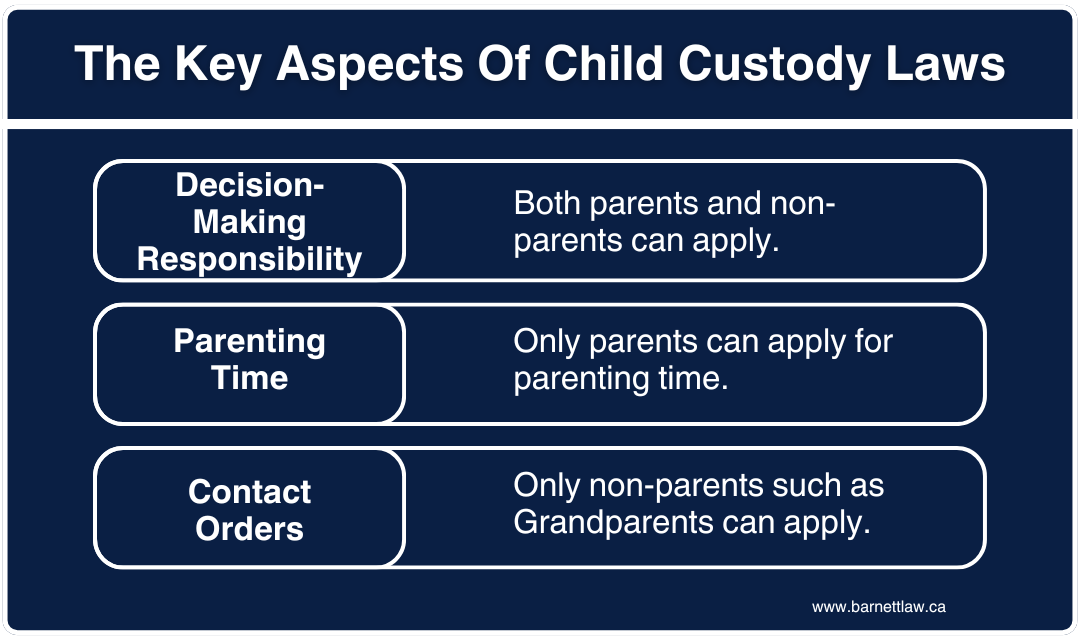
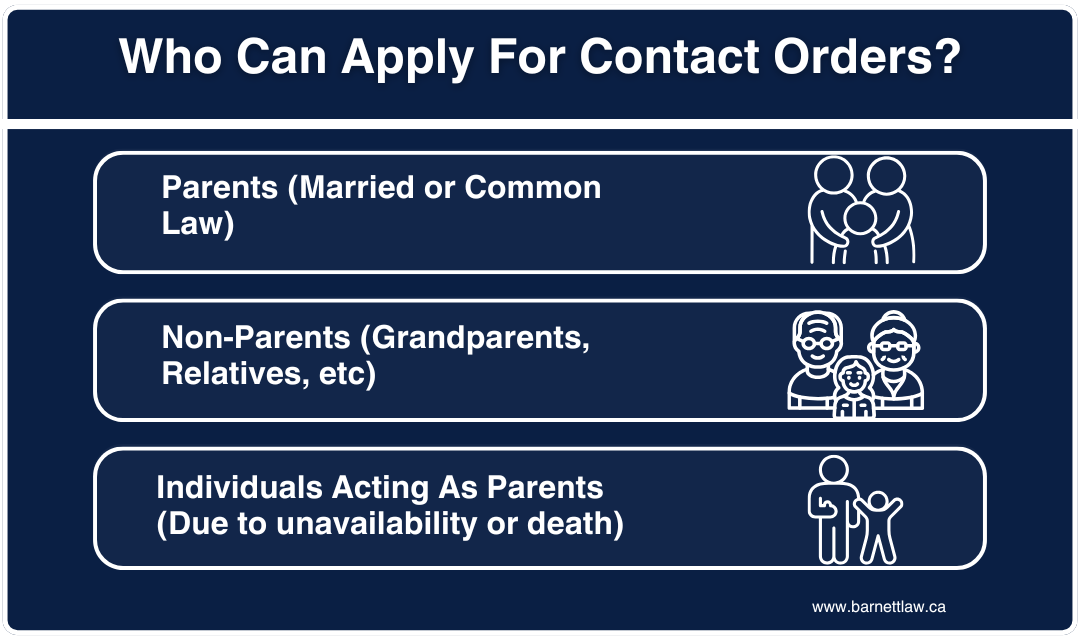
Another key aspect of parenting time is that only parents can apply for it. Grandparents will have to apply for a contact order if they want the child to spend time in their care.
Types Of Parenting Time (Formerly Access) In Ontario
Parenting time arrangements can be developed by couples after separation or divorce in Ontario in a separation agreement or parenting plan, respectively. In some cases, a court may refuse parenting time to a spouse if there is a risk of harm to the child or the parent with the decision-making responsibility.
If you do receive parenting time through an agreement or court order, it can be of the following types:
Shared Parenting Time
Shared parenting time is a situation in which both parents share the time spent with the child. The Child Support Guidelines in Ontario state that shared parenting time is when the child spends at least 40% of their time with each parent.
Split Parenting Time
People often believe split time is a situation in which one parent spends a lesser amount of time with the child. However, that is a misconception. Split parenting time is when you and your spouse have multiple children, and each has one or more children living with them. The time is split per child to ensure both parents get to spend time with all children equally.
Supervised Parenting Time
When the Ontario Superior Court of Justice is concerned about a child’s best interests, it may issue an order of supervised parenting time. This is especially true if there is a safety concern for the involved child. Such a situation allows you and your spouse to ensure a neutral, but safe setting for visitations.
The person supervising the parenting time may be a:
- Friend or relative that parents agree on
- Paid professional, such as a social worker
- Trained individual or volunteer at a Supervised Access Centre in Ontario
Supervised Access Centres are ministry-funded and may accommodate full supervised on-site visits in a group or supervised exchanges off-site. A family lawyer may help you understand the key implications of supervised parenting time better.
FAQs
What Is The Difference Between Decision-Making Responsibility And Parenting Time?
Decision-making responsibility (formerly called child custody) is the legal right one or both parents may receive to make decisions about the child’s care, education, and other major aspects of life. Parenting time (formerly called access) is the amount of time each parent may be allowed to spend with the child, including visitations.
Can Non-Parents Apply For Child Custody Or Parenting Time In Ontario?
Yes, non-parents such as relatives or grandparents can apply for child custody or parenting time in Ontario. For custody, you will have to fill out Form 8 and Form 35.1 and submit it with the Ontario Superior Court of Justice. For parenting time, you must apply for a contact order to legally spend time with the child.
What Factors Does A Court Consider When Making Custody Decisions In Ontario?
The Ontario Superior Court of Justice bases all custody-related decisions on the best interests of the child. Key factors include the child’s physical, emotional, and psychological needs. The court also assesses the bond of the child with each parent and the history of violence before any decision.
Can A Parent Be Denied Parenting Time Under Child Custody Laws?
Yes, a parent can be denied parenting time by the Ontario Superior Court of Justice. Such a verdict is issued if one of the parents poses a risk of harm to the child or the other parent. The court may also deny parenting time if there is a risk that the involved parent will not return the child to the parent with whom the child lives.
Comprehend Child Custody Laws In Ontario With Barnett Law
Navigating child custody laws in Ontario may seem complicated, but a professional family lawyer may assist you. At Barnett Law, we help you understand child custody laws, file for decision-making responsibility and parenting time, and ensure the other parent complies with court orders. Contact us today to learn more about protecting your child under Ontario laws.
Author Profile

- Barnett Law is a trusted and knowledgeable lawyer in Scarborough. Her expertise spans real estate law, family law, adoptions and fertility law. A lawyer by profession and a humanitarian by heart, Athena Narsingh Barnett wants to help people become more familiar with the legal system and be well-informed to make important legal decisions.
Latest entries
 Family LawJuly 8, 2026What Happens To Property After A Divorce?
 Family LawJuly 1, 2026Top 6 Common Mistakes To Avoid During Separation Agreements
 legal guidanceJune 19, 2026Step-By-Step Divorce Process In Ontario (2026 Guide)
 legal guidanceJune 16, 2026Child Custody Laws In Ontario: What Parents Need To Know