
Thousands of Canadians choose to live together without getting married. These relationships carry legal weight in Ontario, and such partners are called common law partners. The rules are different from marriage in ways which can surprise you significantly.
Whether you’re moving in together with someone or have shared a home for years, understanding your rights under the common law Ontario can help you protect yourself and your partner later. Check out our guide below to learn more about common law in Ontario.
What Is Common Law In Ontario?

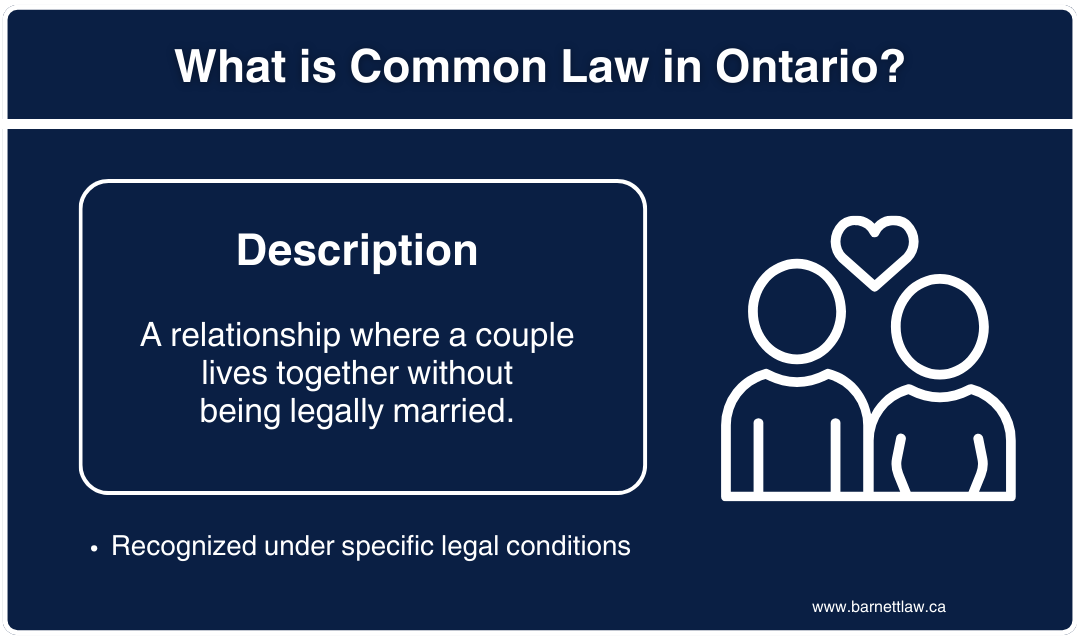
Common law in Ontario refers to a relationship between two people who live together in a conjugal partnership without getting married legally. The term is used across different areas of law, including:
- Family law
- Tax law
- Estate law
Unlike marriage, there is no formal ceremony or marriage registration process for common law partners in the province. Courts recognize the relationship based on how the couple is living together with shared finances, residences, social activities, mutual commitments, and other factors.
How Long A Couple Must Live Together To Be Considered Common Law Partners?
The required cohabitation period for couples depends on different areas of law in Ontario. For example, the Ontario Family Law Act requires three years of cohabitation or any period if the partners have a child together.
If you’re using common law status for tax purposes, the Income Tax Act requires 12 months of cohabitation or any duration if the couple has a child together. Meanwhile, the Succession Law Reform Act, which governs estate rights, requires three years of cohabitation or any period during which a child is living together at the time of death.
The common law status in Ontario is not a single designation that partners can benefit from. For example, you and your partner may qualify as common law partners for tax purposes after one year. However, you will still not yet be entitled to spousal support under the Ontario Family Law Act, which requires cohabitation for at least three years.
What Are The Differences Between Common Law Partners And Married Spouses?
Understanding the difference between a common law partner and a married spouse is critical because many people assume both relationships carry the same legal weight. However, that is not true for all legal areas. Let’s look at the differences in detail:
1. Real Estate Rights
Married couples in Ontario have an automatic right to an equal share in the increase of family property under the Ontario Family Law Act. This is called equalization of net family property in legal terms.
Under Ontario common law rules, partners don’t have this right. Each person generally keeps properties in their own name once the relationship ends, though courts may award a share to the other partner through unjust enrichment or constructive trust claims.
Common law partners also don’t have the same automatic protection as married couples regarding the matrimonial home. One spouse cannot sell or mortgage the matrimonial home without the other’s consent if they’re legally married. Such protection is not available to common law partners even if they have been sharing the same home for many years.
2. Spousal Support
Spousal support obligations exist for both married and qualifying common law couples under the Ontario Family Law Act. If you’ve been cohabitating with your partner for three years (or less if you have children together), you may be eligible to apply for spousal support when separating.
The court will assess the other partner’s ability to pay and determine whether spousal support should be awarded. Married couples don’t need to be married for a specific duration to claim spousal support, making it different than a common law Ontario relationship.
3. Inheritance
Married spouses in Ontario are entitled to a preferential share of $350,000 from the estate, with any remainder divided according to whether children exist. This law doesn’t apply to common law partners in Ontario. You will not inherit your partner’s property by default if they pass away without a will.
Under common law Ontario, a valid will naming the common law partner as a beneficiary is essential for inheritance purposes. Otherwise, the estate will be distributed according to Ontario’s statutory succession hierarchy, in which a common law partner holds no automatic place.
What Are The Rights And Entitlements Of A Common Law Partner In Ontario?
Despite being different from marriage, qualifying common law partners do have meaningful rights in the province. These include:
- Spousal support after three years of cohabitation or less if children are involved
- Child support rights, custody rights, and responsibilities for common law partners and married spouses remain the same
- Government benefits such as CPP survivor benefits and old age security, upon fulfilling one year cohabitation criteria of each program
Consulting a family lawyer may help you understand your rights and obligations under the common law Ontario better.
FAQs
What Are The Rules For Property And Asset Division Under Common Law Ontario?
When a common law relationship ends, the Ontario Family Law Act’s property division rules do not apply as they would to married spouses. Each partner will walk away with what is theirs legally. This means assets and debts in your name will stay with you. Claims may still be pursued through legal remedies such as unjust enrichment or constructive trust.
What Are Some Common Myths And Misconceptions About Common Law Ontario?
Many people believe the myth that a common law partnership is the same as being married after a few years, but that’s not true. Ontario Family Law Act does not treat common law partners in the same way as married spouses.
When To Consult A Common Law Ontario Lawyer?
Consulting a common law lawyer in Ontario is advisable before moving in together, when purchasing property together, when separating, and when a partner dies. An experienced lawyer can help you understand your rights as a common law partner and offer legal support in cases of parenting arrangements.
Contact Barnett Law Today To Learn More About Common Law Ontario
Common law in Ontario can be complex to understand, especially if this is your first common law relationship. In such a case, legal advice is valuable and essential. Whether you’re moving in together and want to draft a cohabitation agreement or separating from a partner, we can help you.
Contact Barnett Law today to set up a meeting with our experienced family lawyer. We would be happy to discuss your case circumstances and assist you in drafting comprehensive agreements.
Author Profile

- Barnett Law is a trusted and knowledgeable lawyer in Scarborough. Her expertise spans real estate law, family law, adoptions and fertility law. A lawyer by profession and a humanitarian by heart, Athena Narsingh Barnett wants to help people become more familiar with the legal system and be well-informed to make important legal decisions.
Latest entries
 Family LawJuly 8, 2026What Happens To Property After A Divorce?
 Family LawJuly 1, 2026Top 6 Common Mistakes To Avoid During Separation Agreements
 legal guidanceJune 19, 2026Step-By-Step Divorce Process In Ontario (2026 Guide)
 legal guidanceJune 16, 2026Child Custody Laws In Ontario: What Parents Need To Know