No couple ever wants to think about how to divide assets such as property after a divorce, but the step is necessary when legally separating or divorcing in Ontario. The process may be difficult, but understanding your rights can help ease things.
A trusted family lawyer can help you navigate the rules related to property division and calculate specific values for you. To learn more about what happens to property after a divorce, dive into our post below.
What Qualifies As Property Under The Divorce Laws?
Many people assume that property only includes real estate assets owned before or after the marriage. However, that is a misconception. The definition of property that can be split during divorce includes the following:
- Home
- Car
- Business
- Furniture
- Pension
- Money
All these assets have to be split equally according to the Ontario Family Law Act. Note that the law of equal property division is only for married couples. Common law partners are not required to split property when legally separating.
How Does Property Division Work In Ontario?
Property acquired during the marriage must be split equally between the spouses when the marriage ends in Ontario. If you owned a property before tying the knot, any increase in value for that property is divided equally after the divorce. The rule usually applies to the family home you lived in with your partner.
Couples are required to share the full value of the family home in all conditions, including:
- When one of you owned the home before the marriage
- When you received the property as a gift
- When you inherited the home
You will have to calculate the “net family property” (NFP) to determine the share of property division. NFP is the value of all debts and assets owned by each spouse during separation or divorce. The difference is calculated, and the payment that one spouse will owe the other spouse is called the “equalization payment” under the divorce laws.
How To Calculate Net Family Property In Ontario?
Net family property is used for dividing property after divorce in Ontario. Each spouse must perform the following steps:
- List everything you own and calculate the total value
- Calculate your mortgages, loans, and credit card debts
- Subtract the total value of what you own from the debt
- Subtract what you brought into the marriage from the figure obtained after step three calculation (savings and properties you owned before marriage)
- Both spouses must compare their final values
Whichever spouse has the higher NFP must pay the difference to the other spouse. This is how both partners walk away with equal division of property after divorce in Ontario.
What Happens To Property After A Divorce?
The Ontario Family Law Act does not treat the matrimonial home like other assets. This is why understanding what happens to property after divorce by categories is easier for couples. Let’s look at it in more detail:
The Matrimonial Home
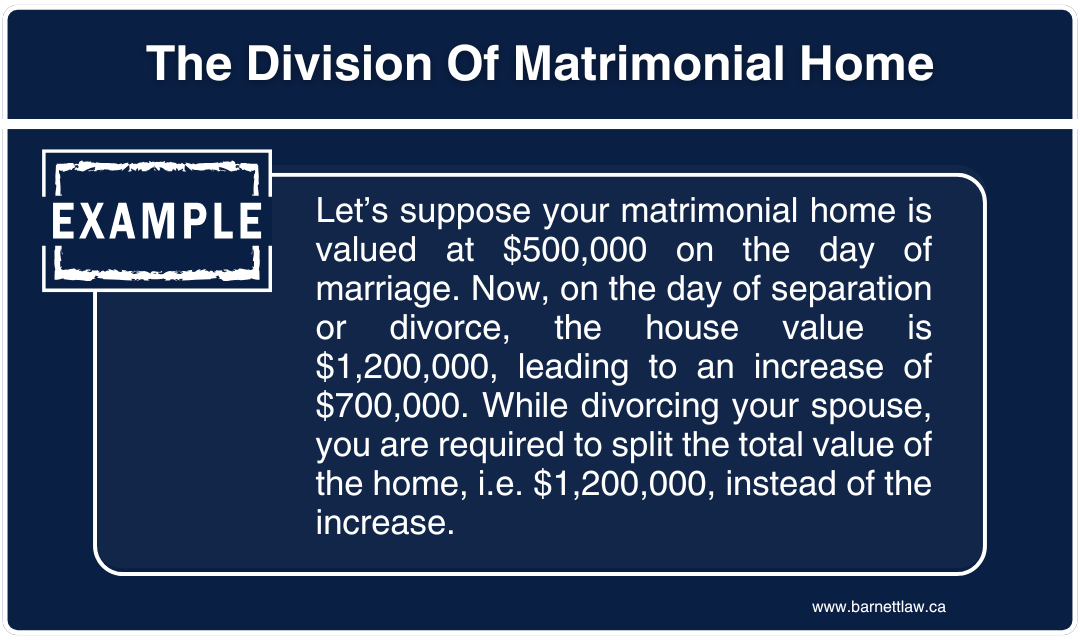
Both spouses have equal rights to live in the matrimonial home after divorce in Ontario. This is regardless of whose name is on the title deed. If you owned the home before the marriage, you cannot deduct its original value when splitting the property.
The full value of a matrimonial home in Ontario is subject to division when divorcing.
This is why speaking to a divorce lawyer Whitby is essential when ending your marriage. They can help you understand the legalities of property division and calculate payment values for you.
Other Property
All property besides the matrimonial home must be split equally when a couple divorces in Ontario. These include houses, cars, boats, pensions (require special calculations), businesses, and furniture.
If one of you owned the property before the marriage, its increase in value will have to be calculated. During the divorce, you can deduct the original value from the current value to find out the increase and only use that for determining property division. Note that this rule does not apply to the matrimonial home.
Excluded Property
Some properties are not automatically split when a couple is divorcing in Ontario. These are called excluded properties and include:
- Personal injury settlements
- Individual gifts (except matrimonial home)
- Inheritance (except matrimonial home)
- Money from life insurance payouts
- Anything mentioned in a prenuptial agreement, postnuptial agreement, or separation agreement
These assets are not divided between the spouses at all under the Ontario Family Law Act. The spouse who owns or received the property will remain the sole owner after the divorce.
Do You Need To Go To Court For Property Division In Ontario?
You don’t have to go to court to determine what happens to property after divorce. An experienced divorce lawyer can help you determine the net family property and equalization payment for property division. If both spouses cooperate with each other during the divorce process, going to court will not be essential.
However, you may go to court if your partner is delaying property division and refusing to pay you an equalization payment. In such cases, a judge will oversee the situation and may issue a court order to ensure your spouse complies with the Ontario Family Law Act.
FAQs
What Is The Equalization Of Net Family Property?
The equalization of net family property is used to determine the value of property after divorce for equal splitting. One spouse must pay the other spouse the final amount of NFP, called the equalization payment. If your partner delays the payment, you can go to court for enforcement.
What Is The Time Limit For Equalization Payment?
The spouse who owes NFP must pay the amount immediately after divorce in Ontario. If your spouse is delaying payment, you have a maximum of six years from the date of separation to file for equalization payment under the Ontario Family Law Act. The time limit reduces to two years if your divorce has already been finalized.
Do All Couples Have To Divide Property After Divorce?
Only married couples have to split property after divorce in Ontario. The split must be equal except for excluded property and the matrimonial home. Common law partners are not required to split property after legal separation, but they may choose to develop a separation agreement and follow its conditions.
Is There A Way To Divide Property Any Way You Want In Ontario?
Yes, you can divide a property in any way you want by developing a prenuptial or postnuptial agreement during the marriage. The marriage contract can include terms of property division that must be followed upon divorce in Ontario. If you don’t have a prenup or postnup, you may develop a separation agreement after discussing with your spouse to decide what happens to property after divorce.
Navigate Property Division In Ontario With Barnett Law Today
Determining how to divide property after divorce in Ontario may be difficult due to multiple calculations and laws, such as the provincial Ontario Family Law Act and the federal Divorce Act.
At Barnett Law, we can help you understand laws related to divorce and determine your net family property value. Our team can also assist you with enforcing any marriage contract that you had with your spouse regarding property division. To learn more about dividing property after divorce, contact us today.
Author Profile

- Barnett Law is a trusted and knowledgeable lawyer in Scarborough. Her expertise spans real estate law, family law, adoptions and fertility law. A lawyer by profession and a humanitarian by heart, Athena Narsingh Barnett wants to help people become more familiar with the legal system and be well-informed to make important legal decisions.
Latest entries
 Family LawJuly 8, 2026What Happens To Property After A Divorce?
 Family LawJuly 1, 2026Top 6 Common Mistakes To Avoid During Separation Agreements
 legal guidanceJune 19, 2026Step-By-Step Divorce Process In Ontario (2026 Guide)
 legal guidanceJune 16, 2026Child Custody Laws In Ontario: What Parents Need To Know